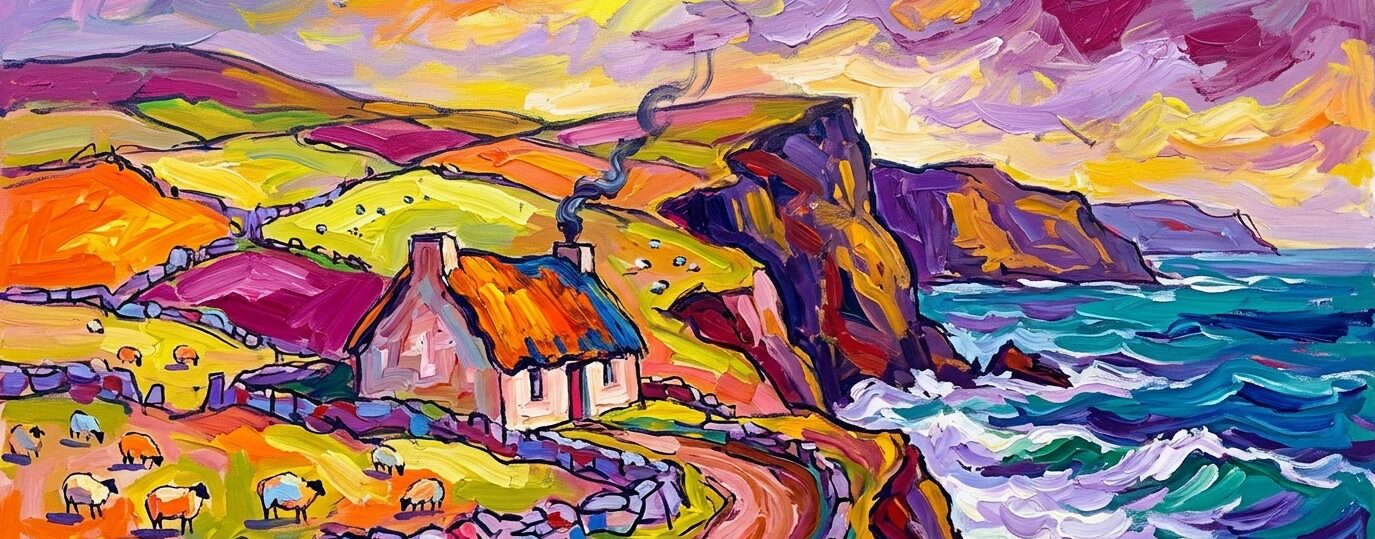
Deidre’s Farewell to Scotland by Anon

A beloved land is yon land in the east,
Alba with its marvels.
I would not have come hither out of it,
Had I not come with Noisi.

Beloved are Dun Fidga and Dun Finn,
Beloved is the fortress above them,
Beloved is the Isle of the Thorn-bush,
And beloved is Dun Sweeny.

Caill Cuan!
Unto which Ainnle would go, alas!
Short we thought the time there,
Noisi and I in the land of Alba.

Glen Lay!
There I used to sleep under a shapely rock.
Fish and venison and badger’s fat,
That was my portion in Glen Lay.

Glen Massan!
Tall is its wild garlic, white are its stalks:
We used to have a broken sleep
On the grassy river-mouth of Massan.

Glen Etive!
There I raised my first house.
Delightful its house! when we rose in the
morning
A sunny cattle-fold was Glen Etive.

Glen Urchain!
That was the straight, fair-ridged glen!
Never was man of his age prouder
Than Noisi in Glen Urchain.

Glen Da Ruadh!
Hail to him who hath it as an heritage!
Sweet is the cuckoo’s voice on bending branch
On the peak above Glen Da Ruadh.

Beloved is Draighen over a firm beach!
Beloved its water in pure sand!
I would never have left it, from the east,
Had I not come with my beloved.

The Sea-God’s Address to Bran by Anon

Then on the morrow Bran went upon the sea. When he had been at sea two days and two nights, he saw a man in a chariot coming towards him over the sea. It was Manannan, the son of Ler, who sang these quatrains to him.

To Bran in his coracle it seems
A marvellous beauty across the clear sea:
To me in my chariot from afar
It is a flowery plain on which he rides.

What is a clear sea
For the prowed skiff in which Bran is,
That to me in my chariot of two wheels
Is a delightful plain with a wealth of flowers.

Bran sees
A mass of waves beating across the clear sea:
I see myself in the Plain of Sports
Red-headed flowers that have no fault.

Sea-horses glisten in summer
As far as Bran can stretch his glance:
Rivers pour forth a stream of honey
In the land of Manannan, son of Ler.

The sheen of the main on which thou art,
The dazzling white of the sea on which thou rowest
about—
Yellow and azure are spread out,
It is a light and airy land.

Speckled salmon leap from the womb
Out of the white sea on which thou lookest:
They are calves, they are lambs of fair hue,
With truce, without mutual slaughter.

Though thou seest but one chariot-rider
In the Pleasant Plain of many flowers,
There are many steeds on its surface,
Though them thou seest not.

Large is the plain, numerous is the host,
Colours shine with pure glory,
A white stream of silver, stairs of gold
Afford a welcome with all abundance.

An enchanting game, most delicious,
They play over the luscious wine,
Men and gentle women under a bush,
Without sin, without transgression.

Along the top of a wood
Thy coracle has swum across ridges,
There is a wood laden with beautiful fruit
Under the prow of thy little skiff.

A wood with blossom and with fruit
On which is the vine’s veritable fragrance,
A wood without decay, without defect,
On which is a foliage of a golden hue.

We are from the beginning of creation
Without old age, without consummation of clay,
Hence we expect not there might be frailty—
Transgression has not come to us.

Steadily then let Bran row!
It is not far to the Land of Women:
Evna with manifold bounteousness
He will reach before the sun is set.

The Flower of Nut-Brown Maids by Anon

Seventeenth century.

If thou wilt come with me to the County of Leitrim,
Flower of Nut-brown Maids—
Honey of bees and mead to the beaker’s brim
I’ll offer thee, Nut-brown Maid.
Where the pure air floats o’er the swinging boats of the strand,
Under the white-topped wave that laves the edge of the sand,
There without fear we will wander together, hand clasped in hand,
Flower of Nut-brown Maids.

My heart never gave you liking or love,
Said the Flower of Nut-brown Maids;
Though sweet are your words, there’s black famine above,
Said the Flower of Nut-brown Maids;
Will gentle words feed me when need and grim hunger come by?
Better be free than with thee to the woodlands to fly;
What gain to us both if together we famish and die?
Wept the Flower of Nut-brown Maids.

I saw her coming towards me o’er the face of the mountain
Like a star glimmering through the mist;
In the field of furze where the slow cows were browsing
In pledge of our love we kissed;
In the bend of the hedge where the tall trees play with the sun,
I wrote her the lines that should bind us for ever in one;
Had you a right to deny me the dues I had won,
O Flower of Nut-brown Maids?

My grief and my torment that thou art not here with me now,
Flower of Nut-brown Maids!
Alone, all alone, it matters not where or how,
O Flower of Nut-brown Maids;
On a slender bed, O little black head, strained close to thee,
Or a heap of hay, until break of day, it were one to me,
Laughing in gladness and glee together, with none to see,
My Flower of Nut-brown Maids.

Roisin Dubh by Anon

There’s black grief on the plains, and a mist on the hills;
There is fury on the mountains, and that is no wonder;
I would empty the wild ocean with the shell of an egg,
If I could be at peace with thee, my Ros geal dubh.

Long is the course I travelled from yesterday to to-day,
Without, on the edge of the hill, lightly bounding, as I know,
I leapt Loch Erne to find her, though wide was the flood,
With no light of the sun to guide my path, but the Ros geal dubh.

If thou shouldst go to the Aonach to sell thy kine and stock,
If you go, see that you stay not out in the darkness of the night;
Put bolts upon your doors, and a heavy reliable lock,
Or, in faith, the priest will be down on you, on my Ros geal dubh!

O little Rose, sorrow not, nor be lamenting now,
There is pardon from the Pope for thee, sent straight home from Rome,
The friars are coming overseas, across the heaving wave,
And Spanish wine will then be thine, my Ros geal dubh.

There is true love in my heart for thee for the passing of a year,
Love tormenting, love lamenting, heavy love that wearies me,
Love that left me without health, without a path, gone all astray,
And for ever, ever, I did not get my Ros geal dubh!

I would walk Munster with thee and the winding ways of the hills,
In hope I would get your secret and a share of your love;
O fragrant Branch, I have known it, that thou hast love for me,
The flower-blossom of wise women is my Ros geal dubh.

The sea will be red floods, and the skies like blood,
Blood-red in war the world will show on the ridges of the hills;
The mountain glens through Erinn and the brown bogs will be quaking
Before the day she sinks in death, my Ros geal dubh!

My Dark Rosaleen by James Clarence Mangan

O my dark Rosaleen,
Do not sigh, do not weep!
The priests are on the ocean green,
They march along the deep.
There’s wine from the royal Pope
Upon the ocean green;
And Spanish ale shall give you hope,
My Dark Rosaleen!
My own Rosaleen!
Shall glad your heart, shall give you hope,
Shall give you health, and help, and hope,
My Dark Rosaleen!

Over hills and thro’ dales,
Have I roamed for your sake;
All yesterday I sailed with sails
On river and on lake.
The Erne at its highest flood
I dashed across unseen,

For there was lightning in my blood,
My Dark Rosaleen!
My own Rosaleen!
O there was lightning in my blood,
Red lightning lightened thro’ my blood,
My Dark Rosaleen!

All day long, in unrest,
To and fro, do I move.
The very soul within my breast
Is wasted for you, love!
The heart in my bosom faints
To think of you, my queen,
My life of life, my saint of saints,
My Dark Rosaleen!
My own Rosaleen!
To hear your sweet and sad complaints,
My life, my love, my saint of saints,
My Dark Rosaleen!

Woe and pain, pain and woe,
Are my lot, night and noon,
To see your bright face clouded so,
Like to the mournful moon.
But yet will I rear your throne
Again in golden sheen;
‘Tis you shall reign, shall reign alone,
My Dark Rosaleen!
My own Rosaleen!
‘Tis you shall have the golden throne,
‘Tis you shall reign, and reign alone,
My Dark Rosaleen!

Over dews, over sands,
Will I fly for your weal:
Your holy delicate white hands
Shall girdle me with steel.
At home in your emerald bowers,
From morning’s dawn till e’en,
You’ll pray for me, my flower of flowers,
My Dark Rosaleen!
My fond Rosaleen!
You’ll think of me thro’ daylight hours,
My virgin flower, my flower of flowers,
My Dark Rosaleen!

I could scale the blue air,
I could plough the high hills,
O I could kneel all night in prayer,
To heal your many ills!
And one beamy smile from you
Would float like light between
My toils and me, my own, my true,
My Dark Rosaleen!
My fond Rosaleen!
Would give me life and soul anew,
A second life, a soul anew,
My Dark Rosaleen!

O the Erne shall run red
With redundance of blood,
The earth shall rock beneath our tread,
And flames wrap hill and wood,
And gun-peal and slogan-cry
Wake many a glen serene,

Ere you shall fade, ere you shall die,
My Dark Rosaleen!
My own Rosaleen!
The Judgment Hour must first be nigh,
Ere you can fade, ere you can die,
My Dark Rosaleen!

Shule Aroon (A Brigade Ballad) by Anon

Sir Charles Gavan Duffy says that the date of this ballad is not positively known, but it appears to be early in the eighteenth century, when the flower of the Catholic youth of Ireland were drawn away to recruit the ranks of the Irish Brigade abroad. It is accompanied by an air of deep sentiment and touching simplicity.—Ballad Poetry of Ireland.

I would I were on yonder hill,
‘Tis there I’d sit and cry my fill,
And every tear would turn a mill,
Is go d-teidh tu, a mhurnin, slan!
Siubhail, siubhail, siubhail, a ruin!
Siubhail go socair, agus siubhail go ciuin,
Siubhail go d-ti an doras agus eulaigh liom,
Is go d-teidh tu, a mhurnin, slan!

I’ll sell my rock, I’ll sell my reel,
I’ll sell my only spinning-wheel,
To buy for my love a sword of steel,
Is go d-teidh tu, a mhurnin, slan!
Siubhail, siubhail, siubhail a ruin! &c.

I’ll dye my petticoats, I’ll dye them red,
And round the world I’ll beg my bread,
Until my parents shall wish me dead,
Is go d-teidh tu, a mhurnin, slan!
Siubhail, siubhail, siubhail, a ruin! &c.

I wish, I wish, I wish in vain,
I wish I had my heart again,
And vainly think I’d not complain,
Is go d-teidh tu, a mhurnin, slan!
Siubhail, siubhail, siubhail, a ruin! &c.

But now my love has gone to France,
To try his fortune to advance;
If he e’er come back, ’tis but a chance,
Is go d-teidh tu, a mhurnin, slan!
Siubhail, siubhail, siubhail, a ruin!
Siubhail go socair, agus siubhail go ciuin,
Siubhail go d-ti an doras agus culaigh liom,
Is go d-teidh tu, a mhurnin, slan!

FOOTNOTES:

Dr. Sigerson renders the chorus in English verse, as follows:—
“Come, come, come, O Love!
Quickly come to me, softly move;
Come to the door, and away we’ll flee,
And safe for aye may my darling be!”

Eamonn An Chnuic, or “Ned of the Hill” by P. H. Pearse

The Outlaw’s Song

“Who is that without
With voice like a sword,
That batters my bolted door?”
“I am Eamonn an Chnuic,
Cold, weary, and wet
From long walking mountains and glens.”
“O dear and bright love,
What would I do for you
But cover you with a skirt of my dress.
For shots full thick
Are raining on you,
And together we may be slaughtered!”

“Long am I out
Under snow, under frost,
Without comradeship with any;
My team unyoked,
My fallow unsown,
And they lost to me entirely;
Friend I have none
(I am heavy for that)

That would harbour me late or early;
And so I must go
East over the sea,
Since ’tis there I have no kindred!”

The Safe-Guarding of my Soul by Anon

I lie on this bed
As I lie in the tomb.
Firmly, O Jesus,
I make my confession to Thee.
Through deeds of my flesh,
Through thoughts of my heart,
Through sight of my eyes,
[Pg 245] Through hearing of my ears,
Through speech of my lips,
Through movements of my feet,
Through everything spoken
Which was not true;
Through each thing promised
And not fulfilled;
Each thing that I did against Thy law,
Or against Thy sacred will,
I ask forgiveness from Thee,
O King of Glory.

She by Anon

The white bloom of the blackthorn, she,
The small sweet raspberry-blossom, she;
More fair the shy, rare glance of her eye,
Than the wealth of the world to me.
My heart’s pulse, my secret, she,
The flower of the fragrant apple, she;
A summer glow o’er the winter’s snow,
‘Twixt Christmas and Easter, she.

The Girl I Love by Jeremiah Joseph Callanan

The girl I love is comely, straight, and tall;
Down her white neck her auburn tresses fall;
Her dress is neat, her carriage light and free—
Here’s a health to that charming maid, whoe’er she be!

The rose’s blush but fades beside her cheek;
Her eyes are blue, her forehead pale and meek;
Her lips, like cherries on a summer tree—
Here’s a health to the charming maid, whoe’er she be!

When I go to the field no youth can lighter bound,
And I freely pay when the cheerful jug goes round;
The barrel is full; but its heart we soon shall see—
Come! here’s to that charming maid, whoe’er she be!

Had I the wealth that props the Saxon’s reign,
Or the diamond crown that decks the King of Spain,
I’d yield them all if she kindly smiled on me—
Here’s a health to the maid I love, whoe’er she be!

Five pounds of gold for each lock of her hair I’d pay,
And five times five, for my love one hour each day,
Her voice is more sweet than the thrush on its own green tree—
Then, my dear, may I drink a fond, deep health to thee!

Would God I Were by Katharine Tynan-Hinkson

Would God I were the tender apple-blossom
That floats and falls from off the twisted bough,
To lie and faint within your silken bosom,
As that does now.

Or would I were a little burnished apple,
For you to pluck me, gliding by so cold,
While sun and shade your robe of lawn will dapple,
And your hair’s spun gold.

Yea, would to God I were among the roses
That lean to kiss you as you float between,
While on the lowest branch a bud uncloses
To touch you, queen.

Nay, since you will not love, would I were growing,
A happy daisy, in the garden path,
That so your silver foot might press me going,
Even unto death.

The Snowy-Breasted Pearl by George Petrie

There’s a colleen fair as May,
For a year and for a day
I’ve sought by every way her heart to gain.
There’s no art of tongue or eye
Fond youths with maidens try
But I’ve tried with ceaseless sigh, yet tried in vain.
If to France or far-off Spain
She’d cross the watery main,
To see her face again the sea I’d brave.
And if ’tis heaven’s decree
That mine she may not be
May the son of Mary me in mercy save!

O thou blooming milk-white dove,
To whom I’ve given true love,
Do not ever thus reprove my constancy.
There are maidens would be mine,
With wealth in hand and kine,
If my heart would but incline to turn from thee.

But a kiss with welcome bland,
And a touch of thy dear hand,
Are all that I demand, would’st thou not spurn;
For if not mine, dear girl,
O Snowy-Breasted Pearl!
May I never from the fair with life return!

The Stars Stand Up by Anon

The stars stand up in the air,
The sun and the moon are set,
The sea that ebbed dry of its tide
Leaves no single pebble wet;
The cuckoo keeps saying each hour
That she, my Storeen, is fled,—
O Girl of the brave, free tresses,
Far better had you struck me dead!
Three things have I learned through love,

Sorrow, and death, and pain,
My mind reminding me daily
I never shall see you again;
You left me no cure for my sickness,
Yet I pray, though my night be long,—
My sharp grief! and my heart is broken,—
That God may forgive your wrong.

She was sweeter than fiddle and lute,
Or the shining of grass through the dew,
She was soft as the blackbird’s flute
When the light of the day is new;
From her feet on the lone hill-top
I have heard the honey dropping;
Why, Girl, did you come to my door?
Or why could you not be stopping?

The Love Smart by Anon

This weariness, this gnawing pain,
Are moving greatly through my brain;
The tears down-dropping from my eyes,
The full of my two shoes with sighs.
I think the Sunday long, and pray
You may come stepping down my way;
Twice over I my lover lack,—
When he departs—till he come back.

My thousand treasures and my love,
At break of summer let us rove,
And watch the flickering twilight dwell
Above the windings of the dell.
I claim no gift of cows and sheep;
But if I ask of thee to keep
My hand within thy circling arm,
Where were the harm? where were the harm?

Farewell! Farewell! the fading light,
Would that last night were still to-night!
Would that my darling, with his smile,
Would coax me to his knee awhile!
Bend down and hear, my tale I’ll tell,
Could you but keep my secret well:
I fear my lover’s gone from me;
O God and Mary, can this be?

The Narrow Road by Douglas Hyde

Once I was happy,
And joyous with that,
Now I am sorrowful
Weary and sick.

Thinking on the colleen
By night and by day,
Hurt by the colleen,
Wounded with love.

The sight of her eyes,
The sweetness of her voice,
It is these that have stricken me
And left me without guidance.

A colleen like she is
Is not in this life,
And she herself has left
Myself without sense.

A colleen like she is
Is not in this world;
Vein of my own heart
Whom I have chosen.

Little hand of my love—
It is whiter than snow;
She hath left us with wounds
And with wandering of the mind.

Three long months
Almost, am I lying;
I am pierced with her arrows
And my heart in torment.

O God of Graces,
Listen to my prayer,
Give death to me
Or give me her.

Look on my lamentations,
Look on my tears;
Were not my thoughts on thee, Storeen,
All these years?

Look on my lamentations,
Listen to me, Aroon,
I am as a sheep,
A sheep without its lamb!

Wilt thou be hard,
Colleen, as thou art tender?
Wilt thou be without pity
On us for ever?

Listen to me, Noireen,
Listen, Aroon;
Put some word of healing
From thy quiet mouth.

I am in the pathway
That is dark and narrow,
The little path that has guided
Thousands to slumber.

Love’s Despair by Anon

“Love’s Despair.” This touching poem was written by a young farmer of Cork who, near the time of his marriage, had gone into the city to buy the wedding-dress for his betrothed. On his way back he heard that she had been married to another man. In despair he flung his presents into the fire. His reason gave way, and he roamed the country henceforth, ever singing the cruelty of Mary and his own misfortunes. His story was well known in Co. Waterford, where he lived a great part of his life. Original in Gaelic Journal, vol. iii., 1887, p. 22.

The literal translation of the second stanza runs as follows:—
“No one knows my case, or how I may find life,
But only the woman who has made me ill;
My cure is not on sea or shore, nor in herb or skill of hand,
My cure is only in the Flower of Youth.
I know not hen from cuckoo, I know not heat from cold,
At no time do I know my friends;
I know not night from day,—but my heart would know its love,
Should she come in time to save me.”

WHAT IS LOVE? From the “Wooing of Etain” by Anon

love much-enduring through a year is my love,
It is grief close-hidden,
It is stretching of strength beyond its bounds,
It is (fills?) the four quarters of the world;
It is the highest height of heaven;
It is breaking of the neck,
It is battle with a spectre,
It is drowning with water,
It is a race against heaven,
It is champion-feats beneath the sea,
It is wooing the echo;
So is my love, and my passion, and
my devotion to her to whom I gave them.

Amorgen’s Song by Anon

Amorgen sang:

Who (but the Poet) knows in what place the sun goes down?
Who seven times sought the fairy-mounds without fear?
Who declares them, the ages of the moon?
Who brings his kine from Tethra’s house?
Who segregated Tethra’s kine?
(For whom will the fish of the laughing sea be making welcome, but for me?)
Who shapeth weapons from hill to hill (wave to wave, letter to letter, point to point)?
Invoke, O people of the waves, invoke the satirist, that he may make an incantation for thee!
I, the druid, who set out letters in Ogham;
I, who part combatants;
I, who approach the fairy-mounds to seek a cunning satirist, that he may compose chants with me.
I am the wind on the sea.